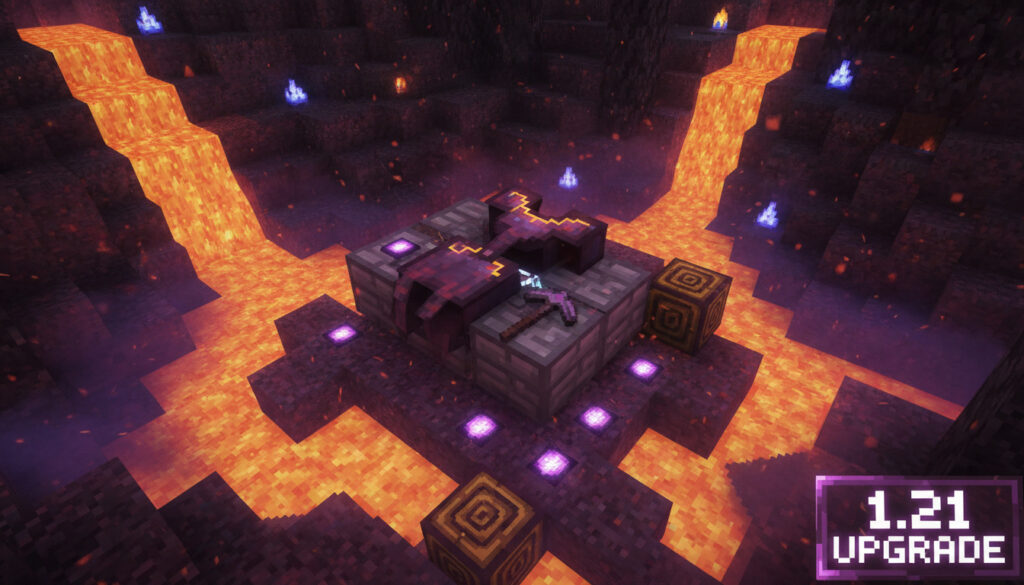
How to Make Netherite Armor – Minecraft 1.21 Upgrade Guide
Netherite armor represents the pinnacle of protection in Minecraft 1.21, offering unmatched durability and knockback resistance that surpasses even diamond gear. Upgrading to this endgame tier requires navigating the dangerous Nether dimension to extract ancient debris, refining the material through specific crafting steps, and utilizing a smithing table to transform existing diamond equipment.
This guide breaks down the complete process for both Java and Bedrock editions, covering resource acquisition, material costs, and the upgrade mechanics introduced in the Nether Update and refined through version 1.21. Whether you’re preparing for the Ender Dragon or establishing a technical survival base, understanding netherite progression is essential for long-term survival.
How Do You Get Netherite Ingots?
36 Ancient Debris + 16 Gold Ingots
Smithing Table
Diamond Armor Set
Nether (Y=8-22)
- Ancient debris generates exclusively in the Nether dimension between Y=8 and Y=22, with peak concentration at Y=15.
- Each netherite ingot requires 4 netherite scrap (from smelted debris) and 4 gold ingots.
- TNT cannon mining yields 200-400 debris per hour solo, making it the fastest legitimate acquisition method.
- A complete armor upgrade demands 4 netherite ingots—one per piece (helmet, chestplate, leggings, boots).
- Ancient debris is blast-resistant; TNT explosions will destroy surrounding netherrack while leaving the ore intact.
- Fire Resistance potions and golden armor are essential safety gear for extended mining sessions.
- Each world chunk generates an average of 1.65 ancient debris deposits.
| Material | Quantity | Source | Notes |
|---|---|---|---|
| Ancient Debris | 36 | Nether (Y=15) | Blast-resistant; mine with diamond pickaxe |
| Netherite Scrap | 16 | Smelting Debris | 4 scrap per ingot required |
| Gold Ingot | 16 | Crafting/Zombified Piglins | 4 gold per ingot required |
| Netherite Ingot | 4 | Crafting Grid | Alternating pattern with scrap |
| Diamond Helmet | 1 | Crafting Table | Prerequisite for upgrade |
| Diamond Chestplate | 1 | Crafting Table | Prerequisite for upgrade |
| Diamond Leggings | 1 | Crafting Table | Prerequisite for upgrade |
| Diamond Boots | 1 | Crafting Table | Prerequisite for upgrade |
According to the Minecraft Wiki, ancient debris generates most frequently between Y=8 and Y=22, establishing Y=15 as the definitive target level for strip mining operations.
What Materials Do You Need for Netherite Armor?
Acquiring netherite armor demands two distinct resource phases: obtaining the diamond base set and gathering netherite upgrade materials. The diamond component requires 24 diamonds total—crafted into a helmet (5 diamonds), chestplate (8), leggings (7), and boots (4). These pieces must already exist before any netherite transformation can occur.
The netherite phase centers on ancient debris, a rare ore found only in the Nether dimension. Mining strategies vary by player resources and technical sophistication. Netherite ingots serve as the bridge material, created by combining netherite scrap (obtained by smelting ancient debris) with gold ingots in a 1:1 ratio.
Each netherite ingot requires exactly 4 netherite scrap and 4 gold ingots arranged in an alternating pattern on the crafting grid. Smelting ancient debris in furnaces, blast furnaces, or campfires yields one scrap per debris block. Gold ingots can be substituted with raw gold or gold blocks, but the 4:4 ratio remains constant.
The Netherite Ingot Recipe remains unchanged between Java and Bedrock editions, ensuring parity in material costs across platforms. Full set completion requires 36 ancient debris (to produce 9 ingots, though only 4 are needed for armor—the excess typically funds tool upgrades).
How Do You Upgrade Diamond Armor to Netherite?
Unlike previous tier upgrades, netherite armor cannot be crafted directly from raw materials. The game requires an existing diamond armor piece as a base template, upgraded through a smithing table interface. This system preserves existing enchantments during the transformation, eliminating the need to re-grind gear.
Can You Craft Netherite Armor Directly?
No direct crafting recipe exists for netherite armor, tools, or weapons. This design decision forces players to engage with the full progression curve, establishing diamond gear as a mandatory prerequisite. Attempting to place netherite ingots and armor-shaped patterns in a crafting table yields no result.
How to Use Smithing Table for Netherite?
The smithing table interface presents two input slots: the left accepts the diamond armor piece, while the right accepts a single netherite ingot. The output displays the upgraded netherite variant with identical durability percentages and enchantment levels preserved. This process consumes the ingot but leaves the diamond base intact within the new item’s NBT data.
Crafting a smithing table requires two iron ingots and four wooden planks of any type. Once placed, the table is accessible immediately without tool requirements. The Minecraft 1.21 Netherite Armor Guide confirms this mechanic remains consistent across all modern versions, including the Tricky Trials update.
Is Netherite Armor Better Than Diamond?
Netherite armor provides substantive advantages over diamond despite sharing the same base armor points (20 for a full set). The improvements manifest in durability, knockback resistance, and environmental immunity—specifically the ability to float in lava rather than sink and burn.
| Attribute | Diamond Armor | Netherite Armor | Advantage |
|---|---|---|---|
| Total Durability | 1,815 | 2,035 (+12%) | 220 additional hits |
| Armor Toughness | 2 | 3 | Better high-damage mitigation |
| Knockback Resistance | 0% | 4% (1 per piece) | PvP/PvE stability |
| Lava Interaction | Burns | Floats | Retrievable on death |
Netherite Armor Enchantments
Netherite accepts the same enchantments as diamond, with Protection IV remaining the standard for general survival. Swift Sneak III (exclusive to leggings) synergizes with netherite’s knockback resistance for exploration. Mending and Unbreaking III effectively render netherite gear immortal under normal usage.
Each piece of netherite armor provides 1 point of knockback resistance, totaling 4 points (or 4%) for a full set. While this percentage appears modest, it prevents the stagger-lock that often proves fatal during skeleton ambushes or cliff-edge combat.
Repair Methods
Repairing netherite armor requires either a second damaged piece combined in an anvil (preserving enchantments at increasing XP costs), or the Mending enchantment which consumes experience orbs to restore durability. The grindstone offers a cheaper repair alternative but strips all enchantments in exchange.
Never use a grindstone on enchanted netherite gear unless intentionally resetting the item. The smithing table upgrade process preserves enchantments, but subsequent anvil repairs accumulate “prior work” penalties that eventually make renaming or repairing prohibitively expensive.
Differences in Netherite Java vs Bedrock
As of version 1.21, netherite mechanics achieve near-perfect parity between Java and Bedrock editions. Both platforms generate ancient debris at identical rates at Y=15. The primary distinctions involve redstone behavior for automated farms—Java allows more precise timing for TNT dupers, while Bedrock handles chunk loading differently for mass-destruction mining systems.
When Was Netherite Armor Introduced to Minecraft?
- : Snapshot 20w06a introduces netherite tools, weapons, and armor to Java Edition, establishing the ancient debris mining and smithing table upgrade systems.
- : Java Edition 1.16 (Nether Update) releases netherite as a full feature, solidifying Y=15 as the optimal mining level.
- : Bedrock Edition 1.16.0 launches feature parity, bringing netherite to mobile, console, and Windows 10 platforms simultaneously.
- : Version 1.20 (Trails & Tales) introduces smithing templates but does not alter netherite upgrade mechanics or costs.
- : Minecraft 1.21 (Tricky Trials) releases with no changes to netherite systems, maintaining consistency with previous versions.
What’s Confirmed About Netherite Mechanics?
Established Facts
- Netherite armor requires diamond gear as a base; no direct crafting exists.
- Y=15 remains the statistically optimal level for ancient debris generation.
- Exactly 4 netherite ingots (16 scrap + 16 gold) upgrade a full diamond set.
- Smithing table upgrades preserve all prior enchantments without level cost.
- Netherite items float indefinitely in lava without burning.
- Java and Bedrock editions share identical drop rates and generation mechanics.
Variable or Uncertain
- Exact ancient debris count per chunk varies by RNG (average ~1.65).
- Anvil repair XP costs scale exponentially based on prior work penalties.
- Future updates (post-1.21) may introduce new armor tiers or netherite variants.
- TNT duper mechanics depend on specific chunk loading and redstone timing.
Why Does Netherite Armor Matter in Survival?
Netherite armor serves as the definitive endgame protection system, bridging the gap between mid-game diamond equipment and late-game technical projects. The 12% durability increase translates to approximately 220 additional damage points absorbed before breakage—a critical margin during extended End raids or Wither skirmishes.
The knockback resistance provides particular value in multiplayer combat and hardcore mode, where environmental kills (lava, void, cliffs) pose greater threats than direct damage. Unlike diamond gear, which permanently despawns when submerged in lava, netherite’s buoyancy ensures recovery after accidental deaths—effectively making the gear “immortal” against the Nether’s primary hazard.
From a progression standpoint, netherite represents the final armor tier in vanilla Minecraft, giving completionists a definitive goal beyond the Ender Dragon. The mining process itself—requiring Nether navigation, blast engineering, and material refinement—constitutes a substantial gameplay loop that extends survival world longevity.
Sources and Technical Verification
“Ancient Debris generates most frequently between Y=8 and Y=22, with a peak at Y=15.”
Minecraft Wiki – Ancient Debris Technical Data
“Netherite items float in lava and have better full-set protection (e.g., 80% damage reduction vs. 76% for Diamond at max).”
Community Verification via technicalminecraft subreddit
Data for this guide derives from the official Minecraft Wiki, Mojang’s 20w06a snapshot documentation, and verified farm mechanics by technical community members ilmango and Gnembon.
Key Takeaways for Netherite Upgrades
Upgrading to netherite armor requires 36 ancient debris (yielding 4 ingots), a complete diamond set, and access to a smithing table. Mine at Y=15 using TNT or efficient branch mining, smelt debris into scrap, combine with gold, and upgrade each piece individually to preserve enchantments. For detailed material breakdowns, refer to the Netherite Ingot Recipe.
Frequently Asked Questions
What is the best Y level for ancient debris?
Y=15 provides the highest spawn rate for ancient debris, with approximately 70% of all Nether generation occurring between Y=8 and Y=22.
Can you repair netherite armor without an anvil?
Yes, the Mending enchantment repairs netherite gear automatically using experience orbs, eliminating the need for anvils or additional ingots during normal gameplay.
Does netherite armor burn in lava?
No, netherite armor floats on lava surfaces and does not burn, making it recoverable after death unlike diamond or iron equipment.
How long does it take to mine a full set of debris?
Manual strip mining requires 3-6 hours depending on luck; TNT cannon methods reduce this to 30-60 minutes for 36 debris.
Can netherite armor have mending and unbreaking?
Yes, netherite accepts all standard armor enchantments including Mending and Unbreaking III, which combined create effectively infinite durability.
Why can’t I craft netherite armor from scratch?
Mojang designed netherite as an upgrade tier to maintain progression pacing, forcing players to obtain diamond equipment before accessing endgame materials.
More related posts
 403 Area Code Canada: Location, Time Zone, and Scam Risks
 Ontario Child Support Calculator – Tables, Guidelines & Calculations
 Superman Post Credit Scene – 2025 Breakdown and DCU Insights
 Ford Ranger Super Duty – Key Specs and Capabilities
 Detroit Pistons vs Celtics Match Player Stats: Box Scores
 How to Parallel Park – Step-by-Step Guide for Beginners
 Real Madrid vs Atlético Madrid Stats: H2H Records & Results
 Lady Gaga Meat Dress – History, Meaning and Where It Is Now